
Quick answer
For 2027, people in Oregon who are under 65 sign up for individual and family health plans on Explore Health, Oregon's own marketplace, instead of HealthCare.gov. Open enrollment runs Nov. 1, 2026 to Jan. 15, 2027. Choose a plan by Dec. 31 to be covered Jan. 1. Two to four companies sell plans in each county (see yours below). Lost your job's health insurance? You can sign up within 60 days after it ends (see your options). Legacy Insurance Group, a licensed independent agency in Woodburn (Gilbert Lopez, NPN 16945680), helps you compare plans and sign up, in English or Spanish, at no extra cost.

Gilbert Lopez, licensed insurance agent (NPN 16945680)
Licensed in health and life insurance for 10+ years. Born and raised in Woodburn. English or Spanish.
What changed for 2027
Starting with 2027 coverage, Oregon no longer uses HealthCare.gov. Health plans for individuals and families are now sold through Explore Health, Oregon's own health insurance marketplace.
Many people call these Obamacare or ACA plans. You still can't be turned down or charged more because of a health condition. What's new for 2027 is where you sign up, which plans are sold, and what they cost.
Oregon open enrollment 2027: the three dates
- Open enrollment starts. That's the yearly window to sign up for, or change, a health plan for 2027.
- Last day to choose a plan for coverage that starts Jan 1, 2027.
- Open enrollment closes. Coverage for plans chosen Jan 1–15 starts Feb 1, 2027.
Used HealthCare.gov before? What's the same and what's new
What's the same
- Plans must cover pre-existing conditions. No one can be turned down or charged more for a health condition like diabetes, asthma or cancer.
- Open enrollment every fall, plus a sign-up window after big changes, like losing your job's health insurance.
- Help paying your monthly bill, if you qualify. Who qualifies changed for 2027 (see Help paying).
What's new
- Where you sign up: Explore Health, Oregon's own marketplace. Had a HealthCare.gov plan? Explore Health sends your renewal notice, and starting Nov. 1 you sign in there to update your application.
- Your plan may change, even if your company stayed (see Which companies are leaving).
- 2027 prices are new, and your help paying gets refigured. It may go up, go down or stay the same.
- Your 2026 coverage stays on HealthCare.gov. Anything about this year's plan still goes through there.
What to do now
- Had a HealthCare.gov plan? Watch for your renewal notice. Explore Health said it would send one to every household enrolled through HealthCare.gov at the end of October. It tells you whether your plan renews or which plan you were matched with. Bought your plan straight from the insurance company? Don't count on being matched. Plan to choose by Dec. 31.
- If you don't choose a plan, Explore Health may renew you, or move you to that match, as long as you're still eligible and you've chosen automatic renewal. Even then, compare first: the state doesn't know your doctors or prescriptions.
- Renewing? If Explore Health asks you for information, like proof of income, send it by Dec. 31 so your help paying is ready for a Jan. 1 start.
- Changing companies? Your new plan starts only after you pay the new company's first bill. Autopay to your old company won't carry over.
Need help switching plans for 2027? Call or text us.
Dates as of October 2026, for 2027 coverage. They may change.
Which companies are leaving for 2027?
For individual plans, the ones you buy on your own and not through work, three changes for 2027:
- Moda Health won't sell these plans in eight counties: Crook, Deschutes, Klamath, Lake, Marion, Polk, Umatilla and Union. New customers can choose Moda only in Clackamas, Multnomah and Washington counties. In the other 25 counties, Moda's 2027 plans are only for people who already have a Moda plan.
- PacificSource won't sell these plans anywhere in Oregon.
- Providence Health Plan won't sell these plans anywhere in Oregon. Providence hospitals and clinics stay open; whether a Providence doctor is in a 2027 plan's network depends on the plan.
If your plan is ending, your renewal notice names the plan you were matched with, from another company. It may have different costs, doctors, pharmacies or covered benefits, so compare before you keep it.
Your company stayed? Your plan can still change. On the state's list, some plans from companies that stayed got a new name, and some were replaced by a different plan. Here's what to do if your plan is ending →
Source: Oregon Health Authority (Oct. 15, 2026) and Oregon Division of Financial Regulation county table, checked Oct. 27, 2026. Plan matches: Explore Health 2026–2027 individual health plan crosswalk (published Aug. 27, 2026), checked Oct. 27, 2026.
Find health insurance companies in your county
Select your Oregon county to see which health insurance companies offer 2027 plans in your area.
For health plans you buy on your own, not through work.
Which plans you can get, and what they cost, depend on your ZIP code, your household and whether you qualify. Every Oregon county has at least two companies.
See all 36 counties
| County | BridgeSpan | Kaiser Permanente | Moda Health | Regence | Total |
|---|---|---|---|---|---|
| Baker | Yes | No | Only for current members | Yes | 2 |
| Benton | Yes | Part of the county only | Only for current members | Yes | 3 |
| Clackamas | Yes | Yes | Yes | Yes | 4 |
| Clatsop | Yes | No | Only for current members | Yes | 2 |
| Columbia | Yes | Yes | Only for current members | Yes | 3 |
| Coos | Yes | No | Only for current members | Yes | 2 |
| Crook | Yes | No | No | Yes | 2 |
| Curry | Yes | No | Only for current members | Yes | 2 |
| Deschutes | Yes | No | No | Yes | 2 |
| Douglas | Yes | No | Only for current members | Yes | 2 |
| Gilliam | Yes | No | Only for current members | Yes | 2 |
| Grant | Yes | No | Only for current members | Yes | 2 |
| Harney | Yes | No | Only for current members | Yes | 2 |
| Hood River | Yes | Part of the county only | Only for current members | Yes | 3 |
| Jackson | Yes | No | Only for current members | Yes | 2 |
| Jefferson | Yes | No | Only for current members | Yes | 2 |
| Josephine | Yes | No | Only for current members | Yes | 2 |
| Klamath | Yes | No | No | Yes | 2 |
| Lake | Yes | No | No | Yes | 2 |
| Lane | Yes | Part of the county only | Only for current members | Yes | 3 |
| Lincoln | Yes | No | Only for current members | Yes | 2 |
| Linn | Yes | Part of the county only | Only for current members | Yes | 3 |
| Malheur | Yes | No | Only for current members | Yes | 2 |
| Marion | Yes | Yes | No | Yes | 3 |
| Morrow | Yes | No | Only for current members | Yes | 2 |
| Multnomah | Yes | Yes | Yes | Yes | 4 |
| Polk | Yes | Yes | No | Yes | 3 |
| Sherman | Yes | No | Only for current members | Yes | 2 |
| Tillamook | Yes | No | Only for current members | Yes | 2 |
| Umatilla | Yes | No | No | Yes | 2 |
| Union | Yes | No | No | Yes | 2 |
| Wallowa | Yes | No | Only for current members | Yes | 2 |
| Wasco | Yes | No | Only for current members | Yes | 2 |
| Washington | Yes | Yes | Yes | Yes | 4 |
| Wheeler | Yes | No | Only for current members | Yes | 2 |
| Yamhill | Yes | Yes | Only for current members | Yes | 3 |
part = Part of the county only
members = Only for people who already have a plan with that company
Source: Oregon Division of Financial Regulation, Final 2027 Individual Plan Coverage by County (form 440-5220, p. 2), checked Oct. 26, 2026, and Moda Health’s 2027 Oregon plan pages, checked Oct. 30, 2026. Companies are listed in ABC order.
Losing your job's health insurance? You don't have to take COBRA
If the health insurance from your job is ending, you have two main choices: COBRA, or your own plan through Explore Health, Oregon's marketplace. Explore Health calls losing job coverage a qualifying life event. It opens a special enrollment period: a sign-up window outside open enrollment.
Your window: from 60 days before your job coverage ends to 60 days after. It counts whether you quit, were laid off, were fired or had your hours cut.
Help paying: with your own plan, you may qualify for help with the monthly bill. COBRA doesn't get that help. Being offered COBRA doesn't take it away. Being on COBRA does. Unemployment benefits count as income when Explore Health figures your help, so tell us what you expect to get.
Losing job coverage before the end of 2026? Coverage for the rest of 2026 still goes through HealthCare.gov. Your 2027 plan goes through Explore Health. Call us before your coverage ends and we'll sort out which one you need and go over your dates with you.
What COBRA is
COBRA is a federal law. It lets you keep your former employer's group plan for a limited time, usually up to 18 months. You usually pay the full monthly price, including the share your employer used to pay, plus a small fee. It generally applies to employers with 20 or more employees.
Work for a company with fewer than 20 employees?
Smaller employer, with fewer than 20 employees? Oregon has its own version, called state continuation: up to nine months on the same group plan, at full price. It also applies if you lost coverage because your hours were cut. You need at least three months of coverage before it ended, and your spouse and kids can keep it too. You have only 10 days to ask for it in writing, counted from when you become eligible or when the insurance company tells you, whichever is later.
How to compare COBRA with your own plan
- Find the monthly COBRA price for everyone you'd cover. It's on your COBRA letter.
- Call or text us for your Explore Health price after any help paying, for the same people.
- Check your doctors, and how much of your deductible you've already met this year. Explore Health plans start a new deductible each Jan. 1.
COBRA can make sense if you're mid-treatment, want to keep a specific doctor, or have already met your deductible for the year. A plan through Explore Health often costs less, especially if you qualify for help paying.
Start dates, paperwork and one COBRA trap
When it starts: pick a plan before your old coverage ends, and the new plan usually starts the first of the month after it ends. Pick after, and it usually starts the first of the month after you choose. If your job coverage ends in the middle of a month, call us before it ends so we can check your dates.
What to keep: the letter that shows the date your job coverage ends. Explore Health may ask for it.
One thing that doesn't count: losing a job plan you never signed up for.
One trap: if you take COBRA and later drop it on your own, that doesn't open a new window. You usually wait until COBRA ends or open enrollment begins, unless you're still within 60 days of losing your job coverage.
We go over both with you before you decide.
Questions? See our common questions, call 971-444-6449 or text "info".
Bronze, silver and gold: how plan levels compare
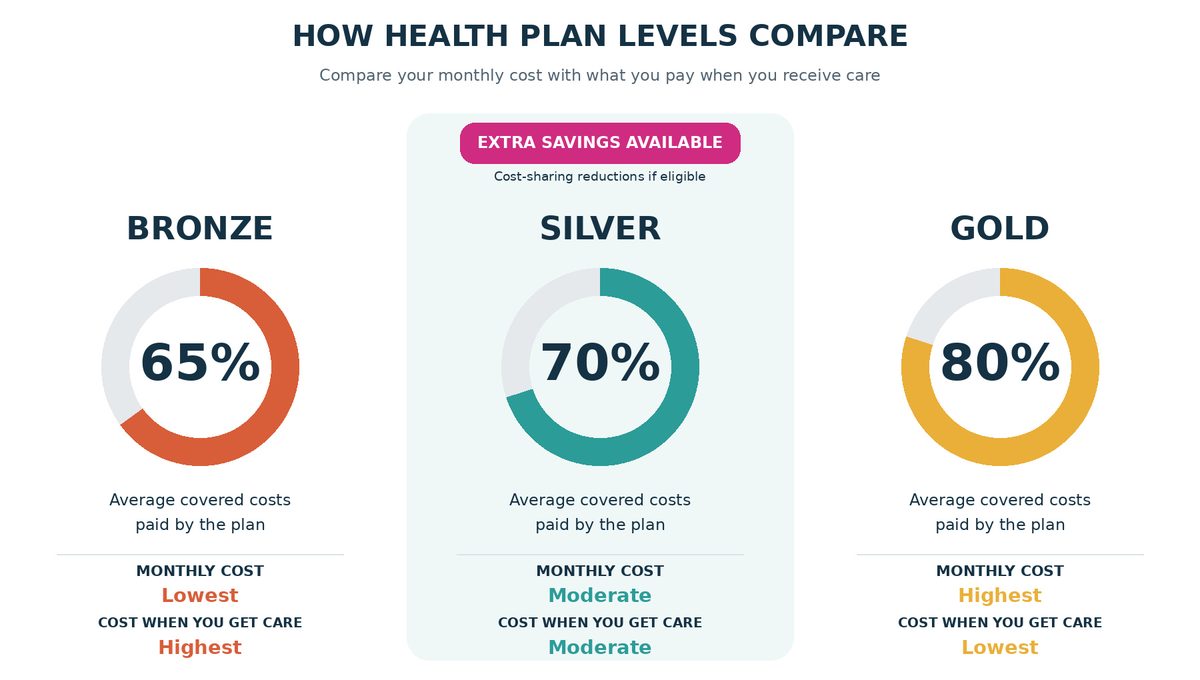
Bronze usually has the lowest monthly price, and you pay more when you get care. On average the plan pays about 65% of covered costs. Silver is in the middle (about 70%). Gold costs more each month, and you pay less when you get care (about 80%). Metal levels show how you and the plan share costs, not the quality of care.
For most households, extra savings on deductibles and copays come only with silver plans, for incomes up to 250% of the poverty level (about $39,900 for one person or $82,500 for a family of four, for 2027 coverage) if you qualify for help paying.
Oregon insurance companies currently aren't offering catastrophic plans for 2027.
How your benefits work: deductible, copays and more
- Monthly payment (premium)
- What you pay every month to keep your plan, whether or not you see a doctor.
- Deductible
- What you pay first for some covered care, like a hospital stay or surgery, before your plan starts paying its share. Example: your deductible is $1,000 and surgery costs $3,000. You pay the first $1,000, then your plan starts helping with the rest. On many Oregon plans, office visits aren't part of the deductible. You pay a set copay instead.
- Copay
- A set fee, like $40 for a visit.
- Coinsurance
- Your share of the bill as a percentage, like 30%, after you've met your deductible.
- Out-of-pocket maximum
- The most you'd pay in a year for covered care in your plan's network. It counts your deductible, copays and coinsurance. After you reach it, the plan pays the full cost of covered in-network care for the rest of the year.
- In-network
- The doctors, clinics, hospitals and pharmacies that have a contract with your plan. Care outside the network can cost more, or may not be covered.
Your monthly payment doesn't count toward your deductible or your out-of-pocket maximum.
Checkups, vaccines and birth control: $0 with your plan's doctors
This is called preventive care. Every Explore Health plan covers it at no cost to you, even before you meet your deductible. Two things have to be true: your doctor is in your plan's network, and that doctor orders and provides the care. It includes:
- Wellness visits to get your recommended checkups and screenings
- Well-baby and well-child visits, and children's shots
- Recommended vaccines for adults, like flu, shingles, tetanus, HPV, hepatitis and pneumonia shots
- Screenings recommended for your age and health, like blood pressure, cholesterol, depression, mammograms, cervical cancer, colon cancer (ages 45 to 75) and bone density (over 65, or younger after menopause)
- FDA-approved birth control your provider prescribes
Coverage can vary, and $0 isn't guaranteed in every case. If the doctor also looks into or treats a new problem during the visit, that part can cost you. More in Why did I get a bill after my checkup?
Oregon also requires every Explore Health plan to cover acupuncture and chiropractic care.
Some plans charge full price even for doctor visits until the deductible
Some plans make you pay the full price for doctor visits, urgent care and generic prescriptions until you meet the deductible. Checkups and other preventive care are still $0. Other plans, like Oregon's Standard plans, let you see your doctor for a copay before the deductible, and your first three primary care visits are $5 each.
We point the full-price plans out and usually help people pick a different one. They can fit some people: you rarely see a doctor, you could pay the deductible in a bad year, and you want to set money aside before taxes in a health savings account (HSA) for medical bills.
Thinking about an HSA?
One catch: every bronze plan on Explore Health can be paired with an HSA, so the HSA label alone doesn't tell you how a plan handles doctor visits. We read each plan's summary with you.
For 2027, you can put up to $4,500 (just you) or $9,000 (family) into an HSA. What you don't use stays in the account. HSA money generally can't pay your monthly bill.
Which plan is best? It depends on three things
- Your doctors: are they in the plan's network?
- Your prescriptions: are they on the plan's drug list, and at what price?
- Your budget: the monthly payment, plus what a bad year could cost.
Explore Health also shows star ratings for plans, based on member surveys and quality measures, though not every plan has one. We look at those with you, too.
How much does health insurance cost in Oregon for 2027?
Prices are new for 2027. Besides the plan you pick, four things set your monthly price:
- Your age Older adults can be charged up to three times what younger adults pay.
- Where you live Oregon has seven pricing areas, so prices can differ from county to county.
- Who's covered Each person adds to the price, but no more than three children under 21 are counted.
- Tobacco Companies can charge adults who use tobacco up to 50% more. Explore Health counts you as a tobacco user if you've used tobacco four or more times a week in the last six months.
Your health and medical history don't change your price.
Help paying can lower your price a lot, if you qualify. We check your price with you, after any help paying, before you choose.
Can I get help paying for a 2027 plan?
Explore Health calls this financial help. The main part is a premium tax credit, and most people don't wait for tax time: it comes off the monthly bill right away. At lower incomes, some silver plans also come with cost-sharing reductions, which are extra savings on deductibles and copays. You can only get this help with a plan through Explore Health. It depends on your household income, how many people are in your household, and whether a job offers anyone in your household affordable coverage.
For 2027 coverage, help generally stops at 400% of the poverty level: $63,840 for one person, $86,560 for two, $109,280 for three, or $132,000 for four. At lower incomes, you may qualify for a different kind of coverage instead. We'll check what fits your household.
The extra help Congress added for 2021 through 2025 hasn't been renewed (as of Oct. 26, 2026).
Job insurance, immigration status and tax rules
Job offers you health insurance? That can block help paying for your own plan. For 2027, Explore Health generally counts a job's plan as affordable if coverage for just you costs less than 10.22% of your household income. Even when your own coverage at work counts as affordable, your spouse and kids may still get help if adding them costs too much. Bring the price sheet from your job's plan and we'll run the numbers with you.
For 2027, help paying is limited to U.S. citizens and nationals, green-card holders, Cuban or Haitian entrants, and people from Micronesia, the Marshall Islands and Palau who live here under the Compacts of Free Association. Other immigrants with an allowed status, like refugees, asylees or people with Temporary Protected Status (TPS), can still enroll, but without help paying. (What if not everyone in my family has the same immigration status?)
Good to know: help paying is a tax credit, so it comes with tax rules. You must file a federal tax return for every year you get it. If you're married, you usually must file jointly with your spouse. There are exceptions, like domestic abuse, abandonment or certain cases of living apart; your tax preparer can tell you if one applies. If you got help before and it wasn't settled on last year's tax return, you may not get help again until it is. Each year you'll get a Form 1095-A for your return: for a 2026 HealthCare.gov plan, from HealthCare.gov; for 2027 coverage, from Explore Health, starting in 2028. If your income ends up higher than you estimated, you may have to pay back some or all of the credit. For tax questions, talk with your tax preparer.
Figures are for 2027 coverage, as of Oct. 26, 2026.
What would you pay for 2027?
Call or text "info" with your ZIP code, the ages of everyone who needs coverage, and your best guess of 2027 household income. We'll show you your price after any help paying.
Why work with us
-
We'll tell you which plan we'd pick
As licensed insurance agents, we're allowed to recommend a specific plan, not just explain your options. We compare the plans in your county with you, then tell you which one we'd pick for you, and why. The choice is always yours.
“Only insurance agents can recommend which plans or coverage might be best suited for you.”Explore Health, Local Help
-
More choices
Besides Explore Health plans, we also have plans outside the marketplace, and dental and vision plans you can buy on their own. Help paying the monthly bill only comes with Explore Health plans, so we'll compare both with you.
-
One local agency for your family
We help with health, dental, vision, life insurance and retirement income. In English or Spanish, at our Woodburn office or by phone.
-
We're here after you sign up
Explore Health asks you to report changes within 30 days. That keeps your help paying right, so you don't owe money at tax time or end up with a gap. Call or text us at 971-444-6449 when something changes.
What counts as a change
- Your income goes up or down
- You start or lose a job, or a job offers you health insurance
- You get married or divorced, or someone in your household dies
- You have, adopt or foster a child
- You move, even within Oregon. Prices can differ by county.
- Someone's immigration status changes
Two clocks to keep straight: 60 days to sign up after you lose coverage, 30 days to report a change once you're on a plan.
How it works
-
Tell us about you
Call or text "info." On the call, we'll ask a few things: who needs coverage, your county, your doctors and prescriptions, and your best guess of your household income. Your income tells us what help you may get with the monthly bill.
-
Compare and choose
We'll show you the plans available where you live, side by side, and explain what each one covers and what it costs. We'll check your doctors and prescriptions with the insurance company before you choose. Then we'll give you our recommendation. The choice is always yours.
-
Sign up
We'll help you apply on Explore Health and pick your plan. Your plan starts on its start date, like Jan. 1, once the insurance company gets your first month's payment. You pay the insurance company directly: not Explore Health, and never us. After that, call us with questions, changes during the year, or next year's renewal.
Already started your application on Explore Health? You can still add us as your agent: choose the option for help from a certified enrollment partner, then search for “Gilberto Lopez” with Legacy Insurance Group.
The consent form, doctor networks and your first payment
Before we help with your application, Oregon requires you to sign a short form saying you want our help. It's called a consent form, and it's good for one year.
Most Explore Health plans use a network, a set list of doctors and hospitals, and some need your main doctor's OK (a referral) before you see a specialist.
Explore Health calls your first month's payment the binder payment. The company must give you at least 15 days after your start date, or 15 days after it sends the bill, whichever is later. Staying in the same plan? There's no new first payment; keep paying your monthly bill as usual.
Your health insurance agent in Woodburn, near Salem
Gilbert Lopez started his career in health insurance. He spent years helping people with their health coverage at a call center before he built Legacy Insurance Group, and he's been helping families with their coverage for more than a decade. He completed Oregon's required training and certification to help people sign up through Explore Health for 2027 coverage.
“I was born and raised in Woodburn. I'll walk you through what each plan covers and what it costs, and I'll tell you which one I'd choose if I were you. I speak English and Spanish, and you can meet with me at my Woodburn office or over the phone.”
Gilbert Lopez · Founder · Health & Life Insurance Agent · NPN 16945680 (verify at NIPR)
Read Gilbert's story →
Hours (Pacific)
- Monday–Friday9:00 AM – 5:30 PM
- Saturday10:00 AM – 3:00 PM
- SundayClosed
Our office is in Woodburn, just up I-5 from Salem and Keizer. We help people across Marion and Polk counties, and anywhere in Oregon by phone or video, from Portland to Medford.
Dental & vision insurance

Dental insurance helps with costs like checkups, cleanings and fillings. Vision insurance helps with eye exams and glasses or contacts. You can get coverage for yourself or your family, whether or not your health plan came through us. Dental and vision insurance isn't only for people under 65. We help people of any age in Oregon.
On Explore Health, you can buy a dental plan only when you buy a health plan at the same time. The dental and vision policies we offer don't need a health plan, so you can get them on their own.
Before you choose, we'll show you the dental and vision policies we offer in Oregon: what each one covers, what it doesn't, and any waiting periods or yearly limits.
Dental and vision insurance doesn't replace health insurance.
Accident & critical illness insurance

Accident insurance and critical illness insurance are extra coverage you can add alongside your health plan.
Accident insurance pays only for covered accidents. Critical illness insurance pays only for the illnesses listed in the policy. Each pays a set amount and adds to your health insurance; it doesn't replace it.
Unlike health plans, some of these policies ask health questions or limit coverage for conditions you already have.
The amount is written in your policy and doesn't depend on your medical bills. It can help with costs like your deductible or bills at home while you recover. Each policy lists what it covers, what it doesn't, and any waiting periods. We'll go over those with you before you apply.
Accident insurance is for injuries. If you want coverage that pays your family if you pass away, that's life insurance. See our life insurance options →
Request a call
Leave your name and number, and we'll call or text you back during business hours. It takes about 30 seconds.
Thanks, .
We got your request and will call or text you during business hours: Monday–Friday 9:00 AM–5:30 PM and Saturday 10:00 AM–3:00 PM (Pacific).
Want to talk sooner? Call 971-444-6449 or text "info" to 971-444-6449.
Oregon health insurance questions for 2027
Is Explore Health Oregon's official marketplace?
Yes. Explore Health is Oregon's own health insurance marketplace, run by the Oregon Health Authority, and starting with 2027 coverage it's where people in Oregon sign up for individual and family plans and get help paying. We're not the marketplace: we're a licensed independent insurance agency in Woodburn, and we help you compare plans and sign up there at no extra cost.
Can I still use HealthCare.gov in Oregon?
Not for 2027 coverage. Starting Nov. 1, 2026, people in Oregon sign up for 2027 plans on Explore Health, Oregon's own marketplace, and if you had a HealthCare.gov plan, you update your application there. The plans and prices are new for 2027, so compare before you renew. HealthCare.gov still handles coverage for the rest of 2026, so if you're not sure which one you need, call us and we'll sort it out.
How many insurance companies sell 2027 plans in my county?
Two to four, depending on where you live. Five counties have four companies everywhere; Benton, Hood River, Lane and Linn have four in part of the county and three in the rest; 21 counties have three; and Crook, Deschutes, Klamath, Lake, Umatilla and Union have two. In Marion and Polk counties, it's three: BridgeSpan, Kaiser Permanente and Regence.
I lost my job. Can I get health insurance now?
If you had health insurance through that job, yes. Losing it opens a special enrollment period, whether you quit, were laid off, were fired or had your hours cut. You can sign up from 60 days before it ends to 60 days after, and you don't have to take COBRA. Losing a job plan you never signed up for doesn't count.
Can I sign up outside open enrollment?
Usually only after certain life events, called qualifying life events, which usually open a 60-day sign-up window called a special enrollment period. Besides losing job coverage, the main ones are getting married, having, adopting or fostering a child, and moving to Oregon or to a new county or ZIP code. Others are coming off a parent's plan, getting an eligible immigration status, and getting out of jail or prison. Some events have extra rules, like having had coverage before a marriage or a move, so call us with the date it happened and we'll check. American Indian and Alaska Native households can sign up any time.
I already took COBRA. Can I switch to Explore Health now?
Usually not until your COBRA ends or open enrollment begins (Nov. 1 to Jan. 15). Dropping COBRA on your own, or stopping the payments, doesn't open a new window. You may be able to switch sooner in two cases: you're still within 60 days of losing your job coverage, or your former employer stops paying its share of COBRA. When COBRA runs out, you usually get 60 days to sign up for your own plan, and we'll check your dates with you.
Retiring before 65? What are my options?
You usually have three choices: COBRA, a retiree plan if your employer offers one, or your own plan. For your own plan, you can sign up from 60 days before your job coverage ends to 60 days after. Help paying comes only with a plan through Explore Health. It's based on your household income for the year, including Social Security and most money you take out of retirement accounts. You usually can't get that help while you're on COBRA or a retiree plan. Dropping either one on your own usually means waiting for open enrollment. Call us before your last day at work and we'll compare all three with you.
Is $500 a month normal for health insurance?
It can be, before any help paying. For 2027, the state's sample silver-plan prices for a 40-year-old in Portland run from $599 to $734 a month. If you qualify for help paying, you could pay a lot less. We check your price with you, after any help paying, before you choose.
What is the cheapest health insurance in Oregon?
There's no one cheapest plan for everyone, because prices depend on your age, where you live, who's covered and tobacco use. Bronze plans usually have the lowest monthly price, but you pay more when you get care, and Oregon insurance companies currently aren't offering catastrophic plans for 2027. If you qualify for help paying, your price can drop a lot, and at lower incomes silver plans also come with extra savings on deductibles and copays, so we compare bronze and silver with you using your own numbers.
Why did I get a bill after my checkup?
This can happen when the visit covered more than prevention. If your doctor looks into or treats a new problem during your checkup, like knee pain or a cough, that part can be billed like a regular visit, with a copay or toward your deductible, and so can tests to figure out a problem. When you book, ask the office how the visit will be billed, and if a bill doesn't look right, call us and we'll go over it with you.
Can I get a health insurance quote?
Yes: call 971-444-6449 or text "info", and we'll look up 2027 prices for the plans sold in your county, with any help paying you qualify for. By phone or at our office, we'll ask for your ZIP code, the ages of everyone who needs coverage, whether anyone uses tobacco and your best guess of your 2027 household income. We never ask for your income, Social Security number or immigration details on our website.
Are you a health insurance broker?
We're licensed independent insurance agents, which is what many people mean by a health insurance broker. Gilbert Lopez is licensed for health insurance in Oregon (NPN 16945680), and we look at all the plans in your county with you, tell you which one fits you best and help you sign up on Explore Health. Our help doesn't cost you extra: your monthly price is the same with or without an agent, because agents are paid by the insurance company.
Can you help me in Spanish?
Yes. Gilbert speaks English and Spanish, and we can do every step in Spanish: the call, comparing plans and signing up. This page is also in Spanish.
What should I have ready?
Have these ready when we talk:
- Names and birth dates for everyone in your household. People who aren't asking for coverage don't need to give a Social Security number or immigration information.
- Social Security numbers, only for the people asking for coverage who have one.
- Immigration document details, only for people asking for coverage who aren't U.S. citizens.
- Your best guess of your household income for 2027. Recent pay stubs or last year's tax return help. Self-employed? Use what you expect to earn after business expenses. Last year's Schedule C is a good place to start.
- Details on any health coverage a job offers anyone in your household.
- A list of your doctors and prescriptions, and any letters about your 2027 coverage.
We never ask for any of this on our website. We go over it with you by phone or in the office.
What if not everyone in my family has the same immigration status?
You can ask for coverage for someone in your family even if others aren't asking for it. Only the person asking for coverage gives immigration information. Explore Health says that information is used only to see if the person qualifies for coverage and help paying. Each person may have different options, and we'll tell you what applies to each one. We don't give immigration advice. If you have questions about your case, talk with an immigration lawyer or a trusted organization before you decide.
Can I help my mom or dad sign up?
Yes, and you're welcome on every call. Your parent needs to be on the call too, and they sign Oregon's consent form for their agent themselves. If you'll be handling things for them, Explore Health lets your parent name you as their authorized representative.
Do you help people in Salem and Keizer?
Yes. Our office is in Woodburn, just up I-5, and we help people across Marion and Polk counties at the office, by phone or by video, in English or Spanish.
Questions about your 2027 health plan?
Call or text. We'll help in English or Spanish.
Sources & disclosures
Reviewed Oct. 30, 2026 by Gilbert Lopez, licensed insurance agent, NPN 16945680.
Dates, prices and rules are for 2027 coverage and may change. Insurance company names appear only as dated facts from the state, in alphabetical order.
See all 50 sources
Oregon Health Authority and Explore Health
- Oregon Health Authority, “Explore Health launches tool to help people navigate health coverage options for 2027” (Oct. 15, 2026)
- Explore Health, open enrollment dates for 2027 coverage (checked Oct. 26, 2026)
- Explore Health, health plans: metal levels and the plan-level chart (65%, 70%, 80%), Oregon Standard plans and the three $5 visits, no catastrophic plans for 2027, at least two companies in every county, and $0 preventive care ordered and provided by an in-network doctor (checked Oct. 27, 2026)
- Explore Health, covered benefits: preventive care, acupuncture and chiropractic (checked Oct. 26, 2026)
- Explore Health, understanding costs: the $1,000 deductible example (checked Oct. 27, 2026)
- Explore Health, health savings accounts: every bronze plan can be paired with an HSA, and 2027 HSA limits of $4,500 and $9,000 (checked Oct. 27, 2026)
- Explore Health, dental plans: dental only with a health plan (checked Oct. 26, 2026)
- Explore Health, quality ratings (checked Oct. 26, 2026)
- Explore Health, financial help: using the credit each month, cost-sharing reductions on silver plans, income that counts (including unemployment benefits), COBRA, and the 10.22% test for job coverage (checked Oct. 27, 2026)
- Explore Health, immigration status and health coverage (checked Oct. 26, 2026)
- Explore Health, automatic re-enrollment for 2027 (checked Oct. 27, 2026)
- Explore Health, renewing your coverage: automatic renewal conditions, and sending requested information by Dec. 31 (checked Oct. 27, 2026)
- Explore Health, Qualifying Life Events: losing job coverage, the 60-day window, the letter showing when coverage ended, other life events, and what doesn't count (checked Oct. 27, 2026)
- Explore Health FAQ dataset: agents and community assisters (“Insurance agents are the only partners who are able to make recommendations on which plans are best for you”), agent pay, coverage start dates, losing employer coverage (including reduced hours), losing a job plan you weren't enrolled in, COBRA ending or an employer stopping its share, a new job's offer, pre-existing conditions, child-only plans, tobacco, pricing areas and metal levels (checked Oct. 27, 2026)
- Explore Health 2027 automatic re-enrollment FAQ dataset: renewal notices at the end of October, a new plan may have different costs, doctors, pharmacies or covered benefits, and savings may go up, down or stay the same (checked Oct. 27, 2026)
- Oregon Health Authority, Explore Health handout “Get Ready to Apply or Re-enroll through Explore Health” (HIM-5477, 2026–27)
- Explore Health, premium payments: the first payment (binder payment), at least 15 days to pay it, and grace periods (checked Oct. 27, 2026)
- Explore Health, reporting changes: report changes within 30 days (checked Oct. 27, 2026)
- Explore Health, taxes: filing every year, filing jointly, last year's credit, and Form 1095-A (checked Oct. 27, 2026)
- Explore Health, ending coverage (checked Oct. 27, 2026)
- Explore Health, document requests (verification) (checked Oct. 27, 2026)
- Explore Health, who counts in your household (checked Oct. 27, 2026)
- Explore Health, employer coverage: the 10.22% affordability test for 2027 (checked Oct. 27, 2026)
- Explore Health, definitions: cited only for the tobacco user and binder payment definitions (checked Oct. 27, 2026)
- Explore Health, Local Help: “Only insurance agents can recommend which plans or coverage might be best suited for you” (checked Oct. 27, 2026)
- Explore Health, 2027 individual plan list (PDF, checked Oct. 27, 2026)
- Explore Health 2026–2027 individual health plan crosswalk (published Aug. 27, 2026): plan matches in Marion and Polk counties (checked Oct. 27, 2026)
- OregonHealthCare.gov, “Oregon has a new health insurance marketplace!”: signing in to Explore Health to update your application (checked Oct. 27, 2026)
- OregonHealthCare.gov, enrollment periods and coverage start dates: plans chosen Jan. 1–15 start Feb. 1 (checked Oct. 27, 2026)
Oregon Division of Financial Regulation
- 2027 final rates and county coverage (form 440-5220; p. 1: sample silver prices for a 40-year-old in Portland; p. 2: plan coverage by county) (PDF, checked Oct. 26, 2026)
- Moda Health, Oregon individual & family plans and 2027 plans: new customers can choose Moda Pathways plans only in Clackamas, Multnomah and Washington counties; Moda Select plans are only for current Moda Affinity members (checked Oct. 30, 2026).
- Standard Provisions for Filing Individual and Small Group Health Benefit Plan Rates (form 440-4872, May 2026: age, tobacco and per-person pricing rules) (PDF, checked Oct. 26, 2026)
- Oregon Standard plan rule, OAR 836-053-0013 exhibit (DFR order ID 5-2026, effective July 1, 2026), and the rule order
Federal
- HealthCare.gov, marketplace in your state: HealthCare.gov still handles 2026 coverage (checked Oct. 27, 2026)
- HealthCare.gov glossary: deductible, copayment, coinsurance, out-of-pocket maximum, network, federal poverty level
- HealthCare.gov, preventive care benefits, preventive care for adults and birth control benefits
- HealthCare.gov, health plan categories (metal levels)
- HealthCare.gov, how insurance companies set health premiums (checked Oct. 26, 2026)
- HealthCare.gov, COBRA coverage and health coverage for retirees (checked Oct. 26, 2026)
- CMS, Oregon geographic rating areas (checked Oct. 26, 2026)
- 45 CFR 147.130 (preventive services with no cost sharing)
- 45 CFR 155.420 (special enrollment periods and coverage start dates, including when you pick a plan before your old coverage ends)
- IRS, Notice 2026-5 (bronze plans and HSAs) and premium tax credit repayment
- CMS, 2027 premium adjustment percentage and cost-sharing parameters
- U.S. Department of Health and Human Services (ASPE), 2026 poverty guidelines
- Congress.gov, H.R. 1834 (checked Oct. 26, 2026)
- U.S. Department of Labor, COBRA continuation coverage and An Employee's Guide to Health Benefits Under COBRA (2022): who COBRA applies to, how long it lasts, what it costs (checked Oct. 27, 2026)
- HealthCare.gov, COBRA (glossary) (checked Oct. 27, 2026)
- IRS, Questions and answers on the premium tax credit (A19, A20): being offered COBRA doesn't block the credit; enrolling in it does (checked Oct. 27, 2026)
- Oregon Division of Financial Regulation, state continuation: Oregon state continuation for employers with fewer than 20 employees (up to nine months at full price; job loss or reduced hours; three months of prior coverage; spouse and children; 10-day written request) (checked Oct. 27, 2026)
Questions or complaints about an insurance agent or company: Oregon Division of Financial Regulation, dfr.oregon.gov, 888-877-4894.