Speak to a Licensed Agent
📞 971-444-6449
Current Oregon rates, how guaranteed acceptance works, and how to know if your parent may qualify for a better plan.

Quick answer: Guaranteed acceptance life insurance is whole life insurance with no health questions and no medical exam. In Oregon, these plans are available for ages 50–80, with coverage usually from $5,000 to $25,000.
The trade-off is the 2-year rule: if death from natural causes happens during the first two years, the family receives the money paid into the policy, plus an extra 10%. Accidental death pays the full amount from day one.
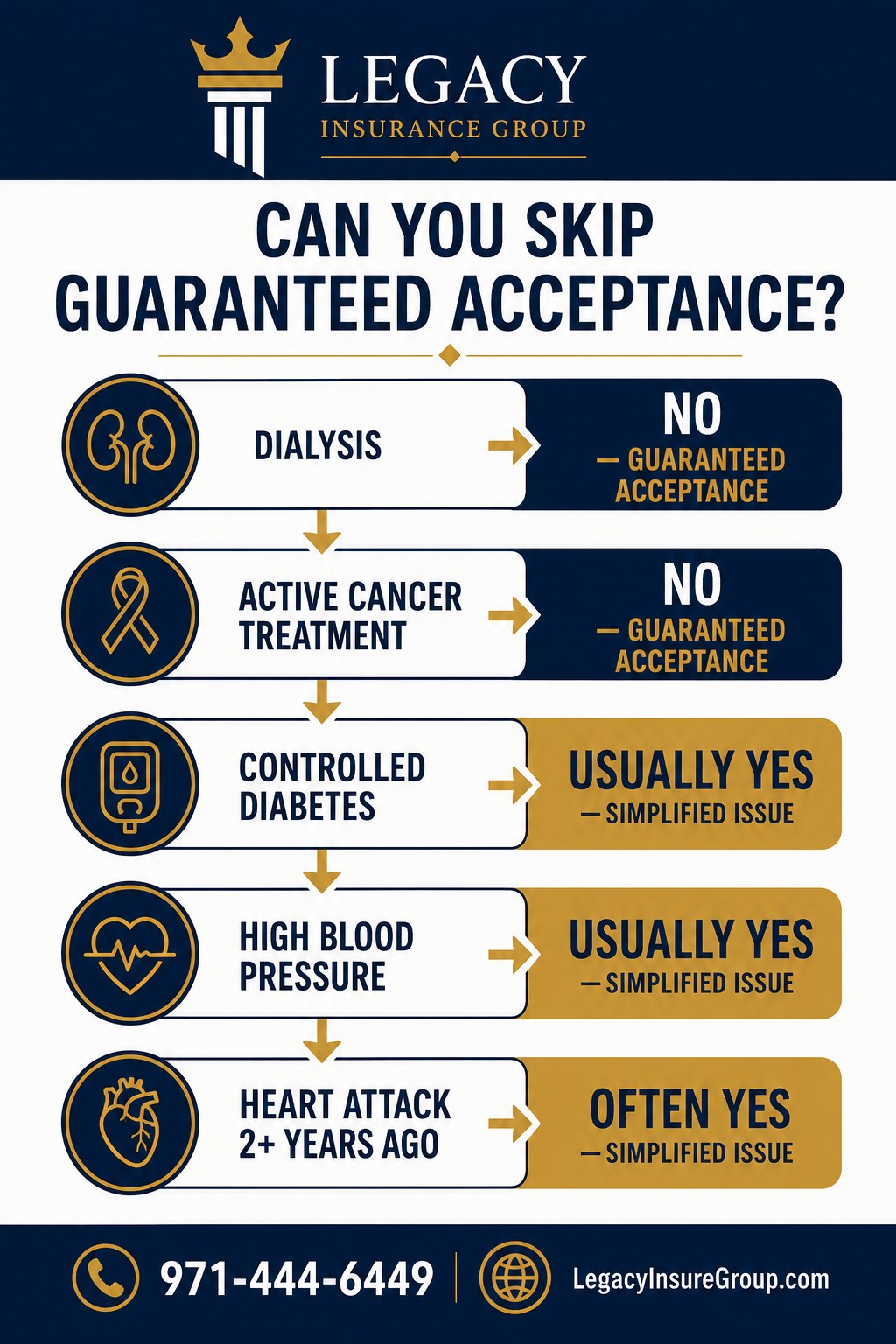
It can be a good fit for someone with serious health conditions — dialysis, active cancer treatment, dementia, hospice, or a recent heart attack or stroke. But here’s the important part: many people who think they need guaranteed acceptance actually qualify for a better plan that asks a few health questions, costs less, and pays in full from day one. That’s the check we make first.
See your rate in about 3 minutes — no medical exam. See your rates first — no name, phone number, or email needed. Guaranteed-acceptance plans show up right next to the simplified-issue options so you can compare.
Guaranteed acceptance life insurance, also called guaranteed issue life insurance, is a type of whole life insurance that removes the health questions. That means:
If you are between ages 50 and 80 in Oregon and applying within the allowed coverage limits, the company does not approve or deny you based on your medical history. That sounds simple, and it is. But there is one major trade-off. Guaranteed acceptance policies come with what insurance companies call a graded death benefit. I prefer to explain it as the 2-year rule.
The 2-year rule is the part most people need to understand before buying guaranteed acceptance coverage. Here is how it works.
If death is caused by an accident, the full coverage amount pays from day one. But if death is from natural causes during the first two years, the full coverage amount does not pay yet. Instead, the family receives all premiums paid into the policy, plus an extra 10%. After the two years are complete, natural causes pay the full coverage amount.
Here is a simple example. Let’s say someone buys a $10,000 guaranteed acceptance policy for $50 per month.
So the 2-year rule does not mean your family gets nothing. It means natural-cause death during the first two years pays back the money paid in, plus 10%. After that, the full policy pays. Because accidents are covered in full from day one, some families also add an accidental death rider for extra protection.
Think of the 2-year rule as the trade-off for being accepted regardless of health. The company asks nothing about your health. The two-year window is what makes that open door possible.
Guaranteed acceptance is not for everyone. It is built for people whose health makes other life insurance options difficult or unavailable. This type of policy may be the right fit if the person applying has:
For these situations, guaranteed acceptance can be a blessing. There are no health questions to answer. The policy was designed for people who need coverage even when other companies have said no. At that point, the question is no longer “Can I get covered?” The better question is “How do we get the most coverage for the money?” That is where comparing companies matters.
This is where many families are surprised. Not every health condition means guaranteed acceptance is the only option. A person may still qualify for a better plan if they have:
In those cases, we usually check a plan with a few yes-or-no health questions first. Insurance companies call that simplified issue. But plain English is better: it is simply a plan that asks a few health questions, does not require an exam, and may give full coverage from day one. (Our burial insurance guide lays the two side by side.)
That is why we do not start by assuming guaranteed acceptance is the answer. We check. Because if your parent qualifies for a plan with a few health questions, they may get lower monthly payments, full coverage from day one, and no 2-year rule on natural causes. That can make a big difference.
Wondering where a specific condition lands? Call us and we’ll tell you which plan type typically says yes for diabetes, heart history, COPD, cancer history and more.
Let’s use one example and stay with the same person. A 65-year-old woman in Oregon wants $10,000 of coverage.
With guaranteed acceptance, the Gerber rate is about $62.61 per month. But if that same woman qualifies for a plan with a few health questions, the rate may be about $41 per month. That is around $21 less per month, or about $260 per year — and the better plan may pay in full from day one.
That is why we always check health-question plans before recommending guaranteed acceptance. Not to deny anyone. To see if there is a better door open.
Here are current estimated monthly rates for $10,000 of guaranteed acceptance coverage in Oregon.
| Age | Corebridge (Men) | Gerber (Men) | Corebridge (Women) | Gerber (Women) |
|---|---|---|---|---|
| 55 | $66.72 | $57.93 | $50.61 | $44.28 |
| 60 | $74.09 | $63.89 | $58.61 | $51.06 |
| 65 | $98.83 | $85.16 | $72.22 | $62.61 |
| 70 | $115.36 | $99.18 | $87.47 | $75.53 |
| 75 | $162.95 | $139.52 | $125.96 | $108.17 |
| 80 | $224.71 | $247.32 | $206.42 | $176.37 |
Estimates based on carrier rate charts for Oregon as of July 2026. Gerber figures assume automatic bank draft (card payment runs higher). Final rates depend on age, state, carrier, payment method, and product availability.
See your own rate in about 60 seconds with our rate calculator — or call or text “info” to 971-444-6449 and we’ll do it together.
You have probably seen Colonial Penn advertised on TV. It is one of the most recognized guaranteed acceptance plans in the country, and the $9.95 price is what most people remember. Here is the part the commercials rarely make clear.
The $9.95 is the price of one “unit” — not the price of your coverage. How much coverage a single unit buys depends on age and gender, and at older ages one unit buys surprisingly little. To reach a meaningful amount like $10,000, a person often needs several units, and the monthly cost adds up to far more than $9.95.
And like every guaranteed acceptance plan, it has the same 2-year rule. This is the part that surprises families most: many people don’t realize their Colonial Penn plan has a two-year waiting period on natural-cause death. It’s rarely spelled out in the ad.
None of this makes Colonial Penn a bad company — it is a real guaranteed acceptance plan, and it helps people who genuinely need no-health-questions coverage. The point is simply to know what you are buying. Ask:
That last question is the important one. If your parent is in decent health, they may qualify for a plan with full day-one coverage and no 2-year rule, often at a similar or lower cost. We don’t sell Colonial Penn and aren’t affiliated with them — we just believe you should compare before you buy.
Ask us for the full unit math — coverage per unit at every age, plus the same $10,000 compared three ways.
Many calls come from adult children. That is completely normal. A daughter may call first because her father does not like talking about insurance. A son may call because his mother received a mailer and wants help understanding it. That is fine — we can start the conversation with you.
When it is time to apply, your parent will need to be involved and give consent. But you can absolutely help them compare options, understand the numbers, and avoid buying the wrong plan. This is especially helpful when someone is older, nervous, or confused by TV ads and mailers.
Myth 1: “If I have diabetes, I need guaranteed acceptance.”
Not always. Type 2 diabetes controlled with medication often qualifies for a plan with a few health questions — which may mean lower cost and full coverage from day one.
Myth 2: “The 2-year rule means my family gets nothing.”
No. During the first two years, natural-cause death returns the money paid in, plus an extra 10%. Accidental death pays the full amount from day one. After two years, natural causes pay in full.
Myth 3: “The TV plans are special.”
Usually they are not. They are often the same type of product — whole life insurance with no health questions and a 2-year rule. The important part is comparing how much coverage you get for the monthly payment.
Myth 4: “If I was declined before, I can’t get life insurance.”
Not true. Guaranteed acceptance exists for people who have been declined or have serious health conditions. The key is knowing which product fits your situation.
Myth 5: “I should cancel my old policy once I find a new one.”
No. Never cancel existing life insurance until the new policy is approved, issued, active, and you are sure you want to keep it. A gap in coverage can create serious problems.
Is guaranteed issue the same as guaranteed acceptance?
Yes. Guaranteed issue and guaranteed acceptance usually mean the same thing. Both describe life insurance with no health questions and no medical exam.
Does guaranteed acceptance pay right away?
For accidents, yes. For natural causes, the full benefit pays after the first two years. During the first two years, natural-cause death returns the premiums paid, plus an extra 10%.
What is the 2-year rule on guaranteed acceptance life insurance?
The 2-year rule means natural-cause death during the first two years does not pay the full coverage amount. Instead, the family receives the money paid into the policy, plus 10%. After two years, natural causes pay in full. Accidental death pays in full from day one.
Can someone on dialysis get life insurance?
Yes. Dialysis is one of the common reasons someone may need guaranteed acceptance life insurance. There are no health questions, so dialysis does not cause a denial.
Can someone with dementia get life insurance?
Possibly. Guaranteed acceptance may be available if the person is within the allowed age range and can legally complete the application. If someone is unable to understand or consent to the policy, that can create issues — so it is best to call and review the situation.
I was declined for term life insurance — can I still get whole life coverage?
Often, yes. Term life insurance uses stricter underwriting — usually a medical exam and lab work — so a condition like diabetes can lead to a decline. Whole life final-expense plans work differently: they ask just a few health questions and require no exam. Someone whose diabetes is well controlled often qualifies for one of these plans with full coverage from day one and no 2-year rule. A term decline doesn’t mean guaranteed acceptance is your only option — it’s worth checking.
Is guaranteed acceptance life insurance expensive?
It costs more than plans that ask health questions, because the company accepts applicants without reviewing their health. The trade-off: no health questions usually means a higher monthly cost and the 2-year rule.
Should I buy guaranteed acceptance life insurance online?
You can, but it is smart to compare first. Buying direct may be convenient, but no one checks whether you qualify for something better. An independent broker can compare guaranteed acceptance against other no-exam options before you decide.
What if my parent already has a life insurance policy?
Do not cancel it yet. We can review the existing policy first. Sometimes it is worth keeping; sometimes there is a better option — but no change should happen until the new coverage is approved and active. Oregon also gives you a free-look period (usually 10 days to return a new policy for a full refund, 30 days if it replaces an existing one).
Guaranteed acceptance life insurance does one thing very well: it gives people a yes when health problems have made coverage difficult. If someone has dialysis, active cancer treatment, dementia, hospice care, or a recent heart attack or stroke, it may be the right answer. But for many families it should not be the first answer — a plan with a few health questions may cost less and pay in full from day one. That is why we check both.
At Legacy Insurance Group, we help Oregon families compare options clearly, without pressure, so they understand what they are buying before they apply. Life insurance does not have to be complicated.
A ten-minute call is usually enough to find out whether you qualify for a better plan than guaranteed acceptance — and what it would cost.
📞 Call or Text 971-444-6449 See Your Rate
This article was last reviewed on July 5, 2026 by Gilbert Lopez, NPN 16945680, a licensed independent insurance broker in Woodburn, Oregon.